Better Understanding Symptoms and Treatments of Poor Throwing Command
Improving command across a group of 15 pitchers with command issues requires nuance and varied approaches for improvement. Command dysfunction varies drastically from case to case which is part of what makes it one of the more interesting areas of player development.
The process of addressing command issues will always start with a comprehensive dive into the pitcher struggling with strike throwing. This will include but not be limited to his performance history, health history, the intent of the pitchers practice, understanding heat maps, pitch metric data, pitcher biomech data, usages, whiff rate, chase rate, and even getting a better understanding of his personal process in competition. This doesn’t come across as objective as some other performance markers but can be a route for a quick fix in some cases. Utilizing accessible data and leaving no stone unturned can light a path on bringing down BB%.
Refining Focal Point
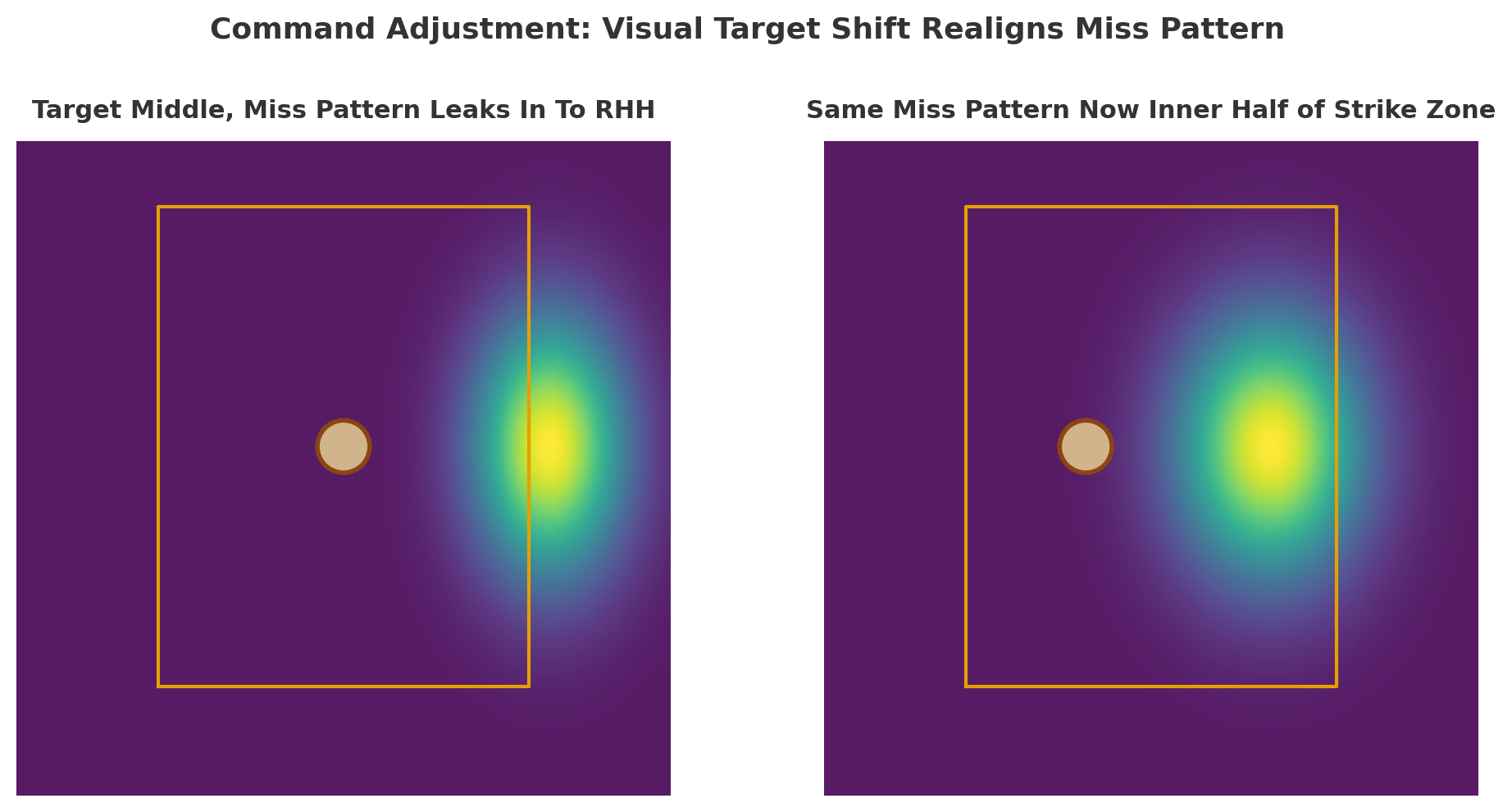
Better understanding your misses and miss trends can push you in the right direction when it comes to figuring out how to be in and around the zone more. While a typical miss trend could point to a different issue, adjusting where you actually aim can be very beneficial.
With access to in-game data you can get a good idea of your own personal heat map on general misses. If you do not have easily accessible data, you can get a good idea of miss trends by watching your outings over video and tracking where you miss most often and when. This can help guide where to aim in competition, by simply adjusting the catcher’s location for all of your pitches or certain ones.
At the professional level, many players across the big leagues have understood this concept for some time now. In fact, many big leaguers and organizations have moved to just aiming middle-middle due to better understanding what league average misses look like. Big leaguers miss their target by 10 to 18 inches on a regular basis. This leads to more pitches looking like strikes, less bad misses and less walks for a lot of professional arms.
If a big leaguer is aiming middle-middle on a majority of his pitches, what makes you think you can nitpick on the outer third of the plate over the course of an outing? The old heads are right, maybe you wouldn’t be at 80 pitches after 4 innings every outing if you actually decided to just try and attack hitters.
Trying to throw your best stuff down the middle is generally good advice, but it is important to consider that adjusting a focal point or catcher’s positioning be very case by case.
Internal Framework
While a trickier area of improvement, we can see large improvements using communication with a pitcher on how he approaches a performance or competition psychologically. Having a good relationship as a coach with a pitcher is a drastically important piece here. It solidifies the ability to ask the right questions comfortably.
Is the pitcher scared of performance? What is the pitcher focused on seeing when they pitch? What is the thought process in general when attacking hitters? Is the pitcher spraying due to actively trying too hard? Is there a large disconnect with the first three pitches of an at bat versus the last three? Is he getting ahead on a regular basis and losing them, or vice versa.
The questions are endless, and we can better navigate them by actually using data. If we have available data that says a certain relief pitcher walks every first hitter he faces we can raise the question as to why this is occurring. Maybe come to find he was only trying to PR on fastballs out of the gate during his appearances. This sounds silly but much crazier communicative disconnects have happened at high levels.
When a player is solely dealing with things like chronic performance anxiety or long slumps, really innovative tools exist outside of baseball skill development. This can include but is not limited to different nutritional supplementing strategies, neurofeedback devices to monitor brainwave activity to better understand what kind of state a pitcher competes best, and high performance mental training books.
For those that like reading, The Inner Game of Tennis is a fantastic read on overcoming self-inflicted performance anxieties. Props to my good friend Brice Crider for putting me on to that one.
Introducing Task Specific Constraints and Implements
If you’ve followed my instagram account for the limited duration of time the page has been active you’ve seen me talk a lot about a constraint led approach (CLA). We have to understand something before we go any further.
From an evolutionary standpoint the brain wants to do well at things it is actively attempting, success was once survival. So on a subconscious level, your body is putting the best possible solution it can together to try and throw strikes.
We can manipulate how the brain puts movement solutions together by putting an athlete in a new environment to complete tasks that look different, but are similar in nature. These solutions better adapt the athlete to the game of baseball.
What does this look like? Probably like making practice harder but in a different way, and then making that practice look closer to the challenges that the game of baseball presents. We can add in different sized and weighted baseballs at random to promote adaptability. We can change the distance, direction and area of an intended target. The target can even be moving.
Limitless possibility with some creativity. Find what makes the athlete click. Trying to hit a location with forever changing implements, directions, and velocities builds the athletic and adaptable thrower.
Think of the amount of shortstops who have never pitched who hop on the mound and throw harder than you, and throw more strikes than you.
This ideology and framework goes into a lot of what I talk about in how I build pitchers. I want them to be elite at throwing and things that look like throwing. Probably a good idea to expose them to variability while keeping the desired skill in frame, and you will build more skillful athletes that better navigate the ups and downs of the skill over the course of their careers.
Leveraging Motion Capture to Reverse Engineer Command Issues
Command can obviously be affected by how a pitcher throws a baseball. While a lot of the training to address a mechanical issue can look similar to some of the stuff we went over on some of the other command posts, we need to better understand how to identify a true mechanical issue that is affecting strike throwing.
Best case scenario you have movement data that the naked eye cannot see. High quality video is the next best thing. First note, when we look at force plate data and moments in time during the throw, it is good to see variability in some certain markers and maybe not as good in others.
When navigating a possible mechanical issue affecting strike throwing it is very important to not look at the highly varied movement that is in question in isolation. A better approach would be to become aware of what is happening around that isolated part. This can include looking at what is happening from the start of the throw leading up to the possible dysfunction, and in some cases what follows.
A real example helps illustrate this. A high level college pitcher is struggling to throw strikes. The pitching coach takes video of a bullpen and sees large deviations in positioning of the glove side in the throw. The pitching coach thinks the inconsistent pull of the glove side is hurting the ability for the pitcher to throw strikes. The coach decides to work on the glove side by making the pitcher conscious of it and prescribing isolated drills in trying to fix the glove side. Nothing gets better.
That same pitcher after the season goes to a facility with a biomechanical motion capture lab. Come to find the pitcher had very inconsistent center of mass velocities upon leg lift, which was leading to large variance in pelvic rotational velocities. This in turn caused that pitcher to develop a bad habit of over counter rotating with the glove side to try and create velocity through a forceful move of the glove side shoulder and arm. This led to a vastly inconsistent torso angle at foot plant leading to poor command outcomes.
The problem resolved once the athlete understood where the issue was coming from and addressed it. The college coach was partially correct in recognizing the glove side shoulder abduction variances but learning where to find the root issue was the moneymaker in this case.
This is just a single example of many similar cases. The throw needs to be understood as a sequence. Issues very rarely exist in isolation. The distal body reflects what is going on at a proximal level. The way I look at a throw is largely influenced from the spine, pelvis, and ribcage. You can still be a good coach without objective movement data if you begin and continue to better understand kinematics and joint interactions.
We still shouldn’t shun deviation in general though. In elite pitchers you will see noticeable deviations of movement strategies between single and different pitch types. No pitcher on the planet is going to throw exactly the same as the previous throw, no hitter is going to take the same exact swing.
In fact, some of the best strike throwers are pitchers who can better navigate these deviations within their own parameters. Where we see these deviations occur matter. Large proximal deviations can cause poor command. This helps explain why we see large fluctuation in distal parts like where the glove is in space.
It is very easy for a player to hyper fixate on an isolated piece of a throw and go down a not so fun rabbit hole. Finding a way to keep the features of the pelvis, torso, and center of mass relatively consistent while also understanding variance that happens around those proximal features is a great place to start in better understanding the connection between mechanics and command. It’s all connected so it should be treated as such.
Stuff+, Arsenal Effects, and Usages
As stated a few times, getting a pitcher to throw more strikes will look different in process. Some processes easier than others. When thinking about what an actual quick fix is for throwing more strikes it usually means changing something we can easily control.
The first thing that comes to mind is usages. Players exist within different developmental windows and throwing a pitch you aren’t good at throwing for strikes in game is mandatory in its development. Now for a fringe draft eligible college arm with a three pitch mix, it will be very important to have as much success as possible.
If this college arm was having BB percent issues over the first month of the season while throwing two of his three pitches for 65% strikes and one of three for 35% strikes, it would probably make a lot of sense to throw that third pitch a lot less to ensure a lower walk rate.
Another direction could be improving arsenal effects, and while this may not actually improve command it can vastly increase strike percent. When we better understand the collective relationship of a pitchers arsenal and usages of that arsenal, we can afford to miss more often due to better disrupting a hitters perception and response to pitches out of the zone.
When a pitcher is struggling to throw strikes and has a large separation in movement, think east west sweeper and sinker or north south four seam and curveball, a bridge pitch can be very beneficial. It provides something that moves less, is easier to throw for strikes, and helps set up the rest of the arsenal.
Lastly, increasing velocity or stuff is going to have a very similar effect on strike percent while not actually improving iz%. Velocity and optimizing pitch shapes narrows the hitter’s decision window which leads to poor decisions. If a pitchers iz% was forty five percent and we elevated every pitch in an arsenal by two miles per hour, the iz% could be exactly the same or slightly worse while the strike percent would actually increase over time.
