Why a Constraints Led Approach and Coaching Application
I have had a lot of coaches across my life in golf, basketball, baseball, olympic lifting, etc. The best coaches I’ve had in my life acted more as architects of an environment rather than an “armchair observer”. They design enriching environments that push athletes toward outcomes without constant over-coaching. I have always observed that when athletes learn to find their own solutions, they show up more frequently when those certain solutions are needed in competition. The best coaches understand feedback loops and keep the athletes within the parameters of the desired goal in my opinion.
Good coaches, trainers, and practitioners understand that all athletes exist on a wide spectrum of biases and skill. They understand that it doesn’t make much sense to chase a single mechanical model with shooting a basketball, throwing a baseball, swinging a club, etc. Many pitching coaches have been known to chase a “perfect delivery” with their pitchers using things like still shots with 2D video for instance. Pushing pitchers down this rabbit hole will rob them of what makes them elite. True development and improvement come from creating conditions that guide the athlete to efficient solutions. Coaching with tasks to build coordination and skill goes much further than coaching with cue slop in this sense. For the pitchers and golfers reading this, how many times have you had a training session with a coach where you finished the day feeling completely lost because you were a victim of 8 different verbal cues throughout a session that you barely understood? Setting up a radar gun and trying to throw 95 down the middle or grabbing a 3 wood and trying to lace a 250-yard shot down the middle of the fairway is probably going to help you stumble into desired outcomes based on your own skills and biases. You’ll never get anywhere in your own training if you're always trying to chase some arbitrary feel. Objective feedback is king, never forget it!
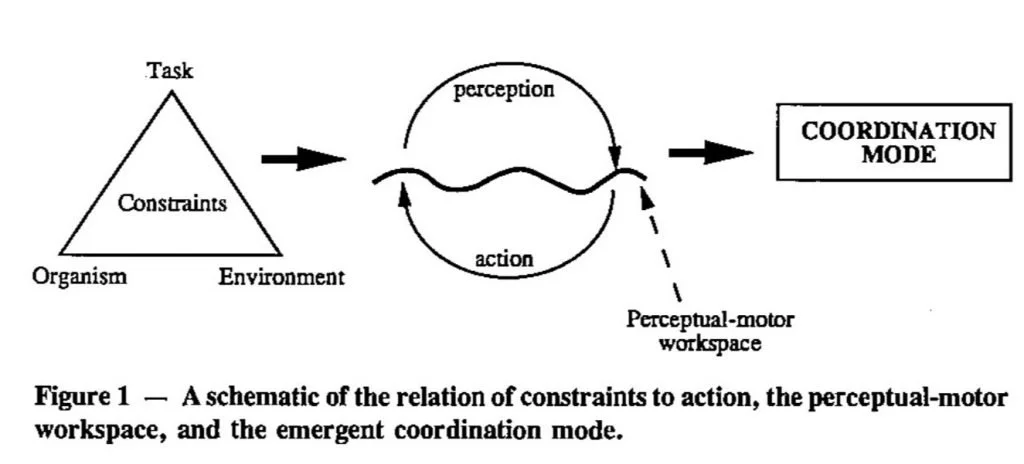
Adjusting constraints for an athlete (whether environmental, task-specific, etc) works because it manipulates the constraints around the athlete to create new experiences that drive adaptation. Rather than repeating the same movement pattern or doing the same task, the athlete is constantly solving slightly new movement problems forcing the nervous system to explore, sense, and organize itself more efficiently. When you change task or environmental constraints (in baseball, things like slope, size, weight, or visual), sensory input floods the brain differently. The motor cortex, cerebellum, and basal ganglia adapt timing and sequencing demands, strengthening neural pathways that support adaptability and robust problem solving under changing conditions.
This in turn also will challenge general proprioception. This is the body’s general sense of position, timing of tension, and movement. These micro-adjustments from ever changing variables and constraints refine sensory feedback loops from the cerebellum and motor cortex that use the tiny adjustments between reps to update the brains idea of movement. This heightened awareness improves the body’s ability to self-correct and find efficient patterns without conscious thought.
The brain will always search for a solution, but anatomy defines the boundaries of that search. Constraints do not necessarily “teach” movement, more so guide the exploration. You’re lighting the path to help shape the conditions that efficient movement emerges through the exploration. The systems coordinate to adapt to meet the demands of the task.
When a pitcher has a goal of refining movement patterns or learning a new pitch, parts of the brain are trying to coordinate new patterns of timing and sequencing. This process isn’t linear and early attempts often look inconsistent or disconnected because the brain is testing different coordination strategies. As coaches, our job isn’t to immediately chase results with tons of verbal communication and “tips” but to guide this exploration with proper manipulation of task-specific constraints. When the environment allows the athlete the ease of solving the desired solution, the learning of desired outcome can begin. Over time we can progress this process to fit into the parameters of conditions of what the player deals with in competition.
We will use development of command in a professional prospect as an example. We have to put the pitcher in an environment where he isn’t just attempting to throw strikes in a basic bullpen setting. The goal should be constantly reorganizing timing and sequencing to improve precision. If the pitcher struggles to locate glove-side fastballs for example, it’s not just a “mechanical” issue. The athlete in every case is attempting to use his best possible solution to solve the issue. A good coach can design structured variability into command work based on the stemming issue which can include alternating pitch distances, focal points, or sequences of targets to force the brain to solve new timing problems each rep. We can also train command in other settings like catch play using implements and small sided games. Important to note that exposure to this kind of variability strengthens the neural coordination ultimately leading to repeatable results (not “mechanics”) via ability to make micro-adjustments. A general rule of thumb when working on any skill, is you can probably make the environment or task more difficult or engaging to further drive skill work in any situation.
